Cinematic Writing & Its Existence

The definition of what constitutes cinematic writing is elusive. Cinema itself is a fluid medium, being as it is reliant on and defined by the technology available to film-makers. Establishing and defining a “cinematic” genre within literature firstly requires an exploration and definition of what constitutes cinema, as opposed to similar visual mediums such as television and, increasingly, video games. Is montage at the heart of cinema, or mise-en-scene? Is adaptability a marker of cinematic literature, or is it based on something more technical, such as structure or the usage of techniques common to both mediums, such as prolepsis? “Cinematic” writing, which by definition must be uniquely differentiated from “normal”, non-cinematic writing, has a dependence on what is defined as the essence of cinema. By first defining what constitutes cinema we thus have a framework from which we can examine whether or not Flannery O’Connor’s novel Wise Blood or Ayn Rand’s The Fountainhead have within them facets that are equivalents to the fundamental essences of the cinema. Despite being a problematic term, both Wise Blood and The Fountainhead can be described as inhabiting a cinematic style of writing.
Andre Bazin argues that, during the early twentieth century, “expressionism of montage and image [constituted] the essence of the cinema.”1 Kellman, in his essay The Cinematic Novel: Tracking a Concept, elaborates on this idea further:
Eisenstein and other Russian theorists like Pudovkin, Kuleshov, and Vertov infectiously argued that the essence of cinematic art is montage: the arrangement of discrete frames to create a visual rhythm. A cinematic novel, then, would be one that is organized as if separate chapters, paragraphs, or sentences were written and then edited into nonlinear patterns.2
Taking Bazin’s and Kellman’s positions that montage was indeed the essence of cinema, at least for a time, as our starting point, the question is raised of whether or not The Fountainhead and Wise Blood contain, at least in some equivalent sense, a similar “expressionism”. Technically they do: the language throughout both texts is not particularly metaphorical, or when it is the meanings are almost transparent and everything is written clearly and precisely, particularly in terms of the imagery created. Flannery O’Connor for instance makes sparse use of adjectives, which makes Wise Blood, to borrow a term from filmic lexicon, seem almost like a novel in black and white. Both novels make use of the temporal techniques which translate easily between the mediums of film and writing, such as prolepsis.3 The Fountainhead reads in parts like a montage, demonstrated in the following passage. Gail Wynand, in some kind of self-amelioration, decides to use his media empire to influence public opinion towards Roark, defending him publicly in all his newspapers. Wynand however is rebuffed as such:
Wynand began to argue the case - with the prominent men he met at business lunches and dinners.... He heard a few answers:
Yes, Gail, yes, sure. But on the other hand I think it was damn selfish of the man....That’s what Lancelot Clokey said in his book....he knows what he’s talking about....”
Yes, Gail, but aren’t you kind of old-fashioned about it....We’re all just a lot of glands and chemicals and whatever we ate for breakfast....”
But look, Gail, he should’ve thought of other people before he thought of himself. I think if a man’s got no love in his heart he can’t be much good. I heard that in a play last night...you own Joules Fougler said it’s a brave and tender stage poem.”
You make out a good case, Gail, and I wouldn’t know what to say against it, I don’t know where you’re wrong, but it doesn’t sound right to me because Ellsworth Toohey....”4
This rapid juxtaposition of separate conversations next to each other constitutes a kind of verbal montage effect. Importantly, despite nearly being a page of dialogue, each separate paragraph is spatially and temporally isolated from the last - the only things connecting them are thematic. With no intermediary statements in-between the speech, the effect is thus similar to how we view montage in film; our experience as the reader is to follow each conversation not in isolation as they would have occurred in reality, but as dialogues bleeding into a singular speech. Important as well is Rand’s use of parallelism, which conveys a sense of Wynand’s isolation with regards to Roark. Rand here is not concerned with temporal or spatial dimensions but rather with dimensions of dramatic space.
The assumption and underlying premise behind labelling Rand as a cinematic writer because of her use of montage, or at least a literary equivalent, is problematic. Firstly, cinema does not have a monopoly on the practice of montage. Arguably it popularised it, but for centuries in literature there has been montage, in its simplest definition as a collection of images occurring consecutively. Again it is also a reductive measure, confused more so by the fact that Rand’s passage is not a visual or pictorial montage described in words, but actually a verbal and in some sense philosophical one. However, The Fountainhead does conform to Bazin’s montage of attraction5, a term coined by Sergio Eisenstein and which Bazin defines as “the reinforcing of the meaning of one image by association with another image not necessarily part of the same episode.”6 Within The Fountainhead Rand employs a kind of montage aesthetics, both visual and verbal, but we can extrapolate this reading even further and describe The Fountainhead as a consistent exploration of montage in several forms. Bazin elaborates even further, stating “montage as used by Kuleshov, Eisenstein or Gance did not give us the event, it alluded to it.”7 The demolition of Cortlandt House is firstly given to the reader by allusion, by montage. The image is focalized around Dominique Francon huddling and then cutting herself, before we are told several pages later that a police officer heads to the scene and discovers Howard Roark next to a dynamite plunger, before being told by him that “You’d better arrest me”8.
If we accept the idea that cinema has as its essence the practice of montage, then perhaps all writing which has some kind of deliberately ordered sequence of images and events could be described as cinematic. This is problematic for the fundamental reason that if all writing, or a large bulk of writing, is cinematic, then cinematic as a generic adjective has no value and there is no specific point of differentiation between cinematic writing and writing in general. Montage however is not all there is to the cinema, as argued by Kellman:
In place of montage, the basis of a free, imaginative cinema was proclaimed to be mise-en-scene—design within each individual frame, long takes, and deep focus. However, it is a curious fact that, though the early Russians' exclusive preoccupation with montage as the foundation of film art has long since been abandoned, discussions of the cinematic novel persist in taking montage as the model for what novels constructed like movies should be like.9
The same problems that arise from adopting montage as an essence of cinema, and thus cinematic writing, apply equally to mise-en-scene. Mise-en-scene, even more so than montage, is fluidly - or perhaps more cynically, uncertainly – defined. Taken at its most basic though, as a consistent application of a signature style, then again it is reductive to describe a genre of writing which has any kind of verbal equivalent, such as Joyce’s stream-of-consciousness, or the minimalist declarative sentences of Cormac McCarthy, as cinematic. However, this does provide a framework with which it is possible to define what could constitute cinematic writing, one which is, at least in a technical sense, useful.  In this case, mise-en-scene can be applied very readily to reading Flannery O’Connor’s Wise Blood. Although Wise Blood has elements of both a literary mise-en-scene and the use of verbal montages, just as The Fountainhead has its own mise-en-scene10, the novel lends itself more readily to classification as cinematic through its style. Wise Blood is narrated in a third-person omniscient style, but still has a clear and strong voice, which unlike The Fountainhead keeps a neutral focalization at all times. The narrator’s timbre is measured, without over-elaboration, and keeps a consistent rhythm throughout the novel. For example: “That morning Enoch Emory knew when he woke up that today the person he could show it to was going to come. He knew it by his blood. He had wise blood like his daddy.”11 This line is typical of the prose style employed throughout Wise Blood by O’Connor. More specifically, Rand’s employment of short, tempered but extremely precise sentences and her sparse use of adjectives is the essence of her narrative style. What makes this cinematic though is the consistency with which O’Connor’s style is employed. If we accept that mise en scene is the essence of cinema, Wise Blood too has a signature equivalent to mise en scene through this dominant narrative style, in a similar way to how Welles’ use of deep focus in Citizen Kane or Ozu’s low shots in Tokyo Story or Eames’ usage of the “doll’s eye view” are the signature modes used when describing their respective mise-en-scenes.
Christian Metz theorises a different take on the essence of cinema, describing the “Image Track”, which he defines “as the visual portion of a synchronized sound film (or the totality of a silent film).”12 There already exists a boundary between film and novels, just as there is with all mediums. Film is comprised of moving images, text, and sound, whereas for novels their primary elements are words. Importantly though, both Wise Blood and The Fountainhead are eidetic novels, and as such could be described as Metz’s image-tracks. Both novels, but especially Wise Blood, are quiet novels. There is a distinctive lack of aural imagery in either novel; O’Connor in particular leaves out details of sound. In fact the only aural clues she gives are through dialogue and are mainly exclamation marks to denote shouting. Rand’s style is more direct. For example, she will include snippets of overheard conversations to convey noisiness, rather than use a simple declarative sentence stating so. But Rand’s dedication to the image can be seen during the collapse of the Cortlandt House. Dominique Francon, having been sent to Cortlandt House to distract the night watchmen, gets caught up in an explosion whose “sound was the crack of a fist on the back of her head.”13 Tellingly, Rand uses a visual, or maybe visceral, kinetic, metaphor to describe the sound of the explosion. Important to both texts and related to their eidetic qualities is their presentation of movement. D.N. Rodowick explains the significance of movement to cinema thus:
On the one hand, the Barthesian notion of the text seems to be literally achieved by conventional processes of cinematic signification. The cinematic text is irreducibly plural: it resists characterization as a univocal sign because it conjoins five distinct matters of expression-phonetic sound, music, noise or sound effects, written inscriptions, photographic registration - and because its processes of signification, its textuality, are constituted irreversibly and ineluctably by the code of movement.14
Due to their character as eidetic, visual novels, movement is prominently presented in both The Fountainhead and Wise Blood. When not presenting counterpoising philosophies, Rand’s descriptions are visual, based on form and movement of people, with small splashes of plain colours and image based metaphors. For example:
In ... 1936 Roark moved his office to the top floor of the Cord Building....When he saw the inscription, ‘Howard Roark, Architect,’ on his new door, he stopped for a moment; then he walked into the office. His own room, at the end of a long suite, had three walls of glass...[through] the broad planes, he could see the Fargo Store, the Enright House, the Aquitania Hotel....At the tip of Manhattan...he could see the Dana Building by Henry Cameron.15
The physical movement of Roark in this passage is easy to visualise, as are the spatial dimensions of his office. That his office has three walls of glass, a transparent material and one with strong primacy as a symbol of modernity, is telling. The Fountainhead switches between two dominant stylistic modes; one of filmic montage and one of rhetoric and invective. However, it is the montage, the visual, which we can understand to lend it cinematic qualities. To give another example of The Fountainhead’s eidetic qualities and Rand’s description of movement:
There were many comfortable chairs around him, but Toohey preferred to remain on the floor. He rolled over to his stomach, propping his torso upright on his elbows, and he lolled pleasurably, switching his weight from elbow to elbow, his legs spread out in a wide fork on the carpet.16
Compare this with the following:
[Peter Keating] left the door to the hall open...throwing a muffler around his throat, with the gesture of flinging a cape over his shoulder. He stepped to the door of the living room, hat in hand, and invited her to go, with a silent movement of his head. In the hall he pressed the button of the elevator and he stepped back to let her enter first.17
Within both passages it is very easy for the reader to visualise the movement of the characters, the language is readable and understandable, plain, not overwrought. Compare this to O’Connor’s description of Hazel’s walk through Taulkinham:
His second night in Taulkinham, Hazel Motes walked along down town close to the store fronts but not looking in them. The black sky was underpinned with long silver streaks that looked like scaffolding and depth on depth behind it were thousands of stars that all seemed to be moving very slowly as if they were about some vast construction work that involved the whole order of the universe and would take all time to complete. No one was paying any attention to the sky...Haze’s shadow was now behind him and now before him and now and then broken up by other people’s shadows....His neck was thrust forward....The glary light from the store windows made his blue suit look purple.18
Again, the movement here is clearly defined. Unlike Rand however, this is a very visually abstracted passage, not limited merely to the presentation of movement. O’Connor is careful to show the dimensions of light and shade, as well as the movement of Hazel’s shadows. Tellingly, he is not looking at the stores, and the description of the “depth on depth” sky connotes a perceptive type experience linked to sight. In other words, O’Connor uses a visual metaphor, we don’t really hear depths of sound of taste depths of flavour, and combines it with visual imagery, using simple colours to describe what Motes sees. The “look” of the passage is also important, the suit looks purple but is blue, the clouds look like scaffolding and it is easy to imagine the sightlines as well of the indiscriminate other people whose shadows are interfering with Hazel’s own. In contrast to Rand, O’Connor employs a more poetic, or even painterly, tone of voice. To simplify, we can read movement in The Fountainhead as framed through montage, whereas in Wise Blood it is the mise-en-scene that dominates how movement is presented.
Ultimately though, the question of what makes cinematic writing comes down to one of representation. Cinema is able to offer experiential relations which are in some sense impossible with words, for various reasons, such as the inherent ambiguity of words. Cinematic writing then could perhaps be understood as the attempt by writers to try and capture with words the qualities of cinema that set it apart from other mediums. That is, cinematic writing seeks to imitate through writing the affective qualities of cinema. In other words, as Wise Blood and The Fountainhead are primarily eidetic novels, then they can be read as having cinematographic qualities. Not only this, but because both texts make use of literary equivalents of filmic techniques, the case can be made that they are indeed cinematic. To draw on Kellman in conclusion:
The existence of a cinematic novel demands delicate equilibrium. If too much weight is placed on the first term, the adjective becomes a substantive, and the pen is supplanted by a camera... Perhaps the most fundamental issue in likening novel to film is an ontological one. Is cinema the child of Lumiere or of Melies, a recording device or a vehicle of fantasy? To begin with Siegfried Kracauer's premise that film is most instinctively a ”redemption of physical reality" is to raise very different expectations of a cinematic novel than to begin with Suzanne Langer's notion that film is "the mode of dream"19


BIBLIOGRAPHY
A Bazin, “The Evolution of the Language of Cinema” in A Gazetas (ed.) An Introduction to World Cinema, McFarland, Jefferson, 2008.

S Kellman, “The Cinematic Novel: Tracking a Concept” IN Modern Fiction Studies, vol. 33, no. 3, 1987, pp.467-477

C Metz & F Meltzer(trans.) “Trucage and the Film” in Critical Inquiry, vol. 3, no. 4, 1977 pp. 657-675

F O’Connor, Wise Blood, Faber & Faber, London, 1968

A Rand, The Fountainhead, 9th edn, Penguin Books, London, 2007

D.N. Rodowick, “The Figure and the Text” in Diacritics, vol. 15, no. 1, 1985, pp. 32-50

1 A Bazin, “The Evolution of the Language of Cinema” in A Gazetas (ed.) An Introduction to World Cinema, McFarland, Jefferson, 2008, p. 121.
2 S Kellman, “The Cinematic Novel: Tracking a Concept”, Modern Fiction Studies, vol. 33, no. 3, 1987, p. 473
3 Interestingly, prolepsis is never used in Vidor’s film adaptation of The Fountainhead, but cinematic writing is perhaps more about how films inform novels, rather than the other way around.
4 A Rand, The Fountainhead, 9th edn, Penguin Books, London, 2007, p. 657-658
5 Bazin, op. cit., p. 120
6 Ibid.
7 Ibid.
8 Rand, op. cit., p 648
9 Kellman, op. cit., p. 473
10 Again though, The Fountainhead’s primary facet with which to describe it as cinematic comes from Rand’s employment of montage. In other words, its mise-en-scene is montage, which differentiates it from Wise Blood.
11 F O’Connor, Wise Blood, Faber & Faber, London, 1968, p. 52
12 C Metz & F Meltzer(trans.) “Trucage and the Film” in Critical Inquiry, vol. 3, no. 4, 1977 p. 657
13 Rand, op. cit., p. 644
14 D.N. Rodowick, “The Figure and the Text” in Diacritics, vol. 15, no. 1, 1985, p. 35
15 Rand, op. cit., p. 538
16 Rand, op. cit., p. 489
17 Rand, op. cit., p. 382
18 O’Connor, op. cit., p. 23
19 Kellman, op. cit., p 474-475

Tokyo Story//Dull Title

Tokyo Story, in contrast to the other films presented to us so far this semester, examines modernity through the thematic focus of the family. Compared with Walter Ruttman's Berlin, in which the forces of modernity are highlighted and championed, or Eames' Toccata for Toy Trains, in which industrialised forces of modernity, at least in toy form, have entered the home, Tokyo Story as a film resists this. There is a quiet, underlying sadness permeating the film, embodied in the figures of the Shukichi and Tomi. One of the final dialogues of the film is between Kyoko and Noriko, where Kyoko states "Isn't life disappointing?" to which Noriko replies "It is." It's this sort of quiet despair that seems to be the dominant mood of the film. It is after all made in the aftermath of World War 2. You can't help but feel the Hirayama's sense of loss as their children, drawn closer and closer to modern life and the ceaseless pace of work and industrialisation, gradually drift further and further away.

Throughout Ozu's film, the symbol of the house is a near-permanent fixture within every shot. One of the earliest scenes is a long shot of Kyoko, walking to work and framed on either side by domestic houses. Apart from a few selected scenes, for example when the Shukichi and Tomi are at the hot-baths, or when they are travelling through Tokyo by tourist bus, the family home is present in every single scene. The dominant shot is the low-angled mid shot framed by wooden panels.  There are other symbols repeatedly thrown in besides the house, such as smoke-stacks, powerlines and that other familiar trope of modernity the train, but these serve more as background or as distractions from the main preoccupation of the Tokyo Story: the family unit.


 Throughout Tokyo Story, the characters are framed by doors and hallways, the bulk of their time is spent sitting down in the company of their family whilst the camera positions us almost as a silent member of the Hirayama family.


The prolific use of low shots whilst the Hirayama family are sitting places us directly at their table. Furthermore the shot-reverse shots employed position the film’s characters directly in the centre of the screen, and by extension directly in our field of vision, just as if we were seeing things from Noriko's or Shukichi's or Tomi's view. Something else Ozu employs is the reversal of camera angles, often we will be viewing characters from one side of a room throughout their conversations, only for their to be a 180 degree flip to the other side, signalling the end of the scene.

I suppose how I viewed it was not that Ozu was evangelically preaching that the forces of modernity would lead to the collapse of the family (a shift in how we conceptualise the family has arguably arisen however) but that with any great technological progression there accompanies with it a lamentation for what has been lost during as a result of it. Sentimentality in other words. But also something else. One of the moust touching scenes in the film occurs roughly half an hour in: the grandmother, having taking her brattish grandson out to play in a field whilst trains and powerlines exist blurrily in the background, muses over what she thinks his occupation will be when he grows up. She asks if he will be a doctor when he grows up and then, quite poignantly foreshadowing her own death, muses “By the time you become a doctor, I wonder if I'll still be here”. There's a certain duality within the film I think between the industrialised exterior spaces of Tokyo and Osaka and the seemingly pre-industrial familial interior spaces.


Something I think prevalent in Tokyo Story is this idea of families as a burden. Both Shukichi and Tomi, whilst wanting to spend time with their children, are wary of being a burden upon them. In contrast with the feelings of Koichi, Shige and Kaizo however, there feelings arise out of guilt. There is also a sense that Koichi and Shige regard their parents as burdensome, particularly Shige, who suggests that her and Koichi pay to send them to the hot springs. As well as this, it is Shige who calls up Noriko asking her to take Shukichi and Tomi sight-seeing and who demands of Kyoko Tomi’s finest clothes after her death. It's not this sense of families as a burden is neccessarily bad, I think it's quite a common experience. I know I've definitely felt so at times. In some sense it is depressing though, and I am constantly reminded of a Patrick White quote from The Tree of Man. The daughter of the novel's protagonist, having received a visit from him and seeing him home, "puts him on the train and resumes her life", or something along those lines.

Overall though Tokyo Story is an extremely tender film. Despite being seemingly gloomy, and the selfishness of the children being almost grating, Noriko does exist as a figure of balance. But the film does end with a sense of isolation. The final scenes are Noriko alone on a train back to Tokyo, whilst Kyoko stares solemnly through her classroom window as it passes and Shukichi kneels alone in his house, tears welling in his eyes, followed by a long shot, which interestingly is one of the few high-angled shots employed in the film, of the Hirayama home in Onomichi, a steamboat passing by.  

Fountainhead Fail (In Several Quotes)

Instead of posting a rage-coloured polemic against Rand and her bullshit philosophy I thought I'd focus instead on her stylistics. That might seem fruitless as The Fountainhead is pretty much an essay masquerading as a novel, but being framed as a novel as it is then it demands close reading as any other novel. So here's a list of quotes which, for one reason or anoyher, are (hopefully) self-evidently bad. As in school-kid bad. Anyway, what I've done is compiled a list of quotes that I found particularly grating on first reading. Of course, this is not an exclusive list and I was tempted to just copy and paste the entire novel, but that would be lazy. If there's anything about Rand I noticed whilst reading The Fountainhead, it's that she absolutely cannot write sex scenes. Or dialogue, which in the novel is almost always stilted and unrealistic. It's also fairly cliched, even for a novel 50 years old or whatever. But maybe people actually spoke like that i the 40s or 50s. Rand's writing is also extremely repetitive. I also imagine that any Feminist critique applied to The Fountainhead would absolutely tear it to shreds, but as schools of thought go Feminist Theory is one of my weaker points. Also, there's a definite ginger-discrimination thread running through the novel, Roark being of orange-hair and all. 

Speculation end, quotes now:

1.)"All right Peter. I think I know. You don't have to meet him if you don't want to. Just tell me when you want it. You can use me, if you have to. It won't change anything.

When he raised his head, she was laughing softly.

"You've worked too hard, Peter. You're a little unstrung. Suppose I make you some tea?"

"Oh, I'd forgotten all about it, but I've had no dinner today. Had no time."

"Well of all things! Well, how perfectly disgusting! Come on to the kitchen, this minute, I'll see what I can fix up for you!"

-----------------------------------------------------------------

2.)When they lay in bed together it was-as it had to be, as hte nature of the act demanded-an act of violence. It was surrender, made the more complete by the force of their resistance. It was an act of tension, as the greatest things on earth are things of tension. It was tense as electricity, the force fed on resistance...it was tense as water made into power by the restraining violence of a dam. The touch of his skin against hers was not a caress, but a wave of pain, it became pain by being wanted too much...It was an act of clenched teeth and hatred, it was the unendurable, the agony, an act of passion- the word born to mean suffering- it was the moment made of hatred, tension, pain- the moment that broke its own elements, inverted them, triumphed, swept into a denial of all suffering, into its antithesis, into ecstasy.

-----------------------------------------------------------------

3.)"However, that's how it's done. You see, reasons require scales to weigh them. And scales are not made of cotton. And cotton is what the human spirit is made of-you know, the stuff that keeps no shape and offers no resistance and can be twisted forward and backward and into a pretzel. You could tell them why they should hire you so much better than I could. But they won't listen to you and they'll listen to me. Because I'm the middleman. The shortest distance between two points is not a straight line-it's a middleman....Such is the psychology of a pretzel."

-----------------------------------------------------------------

4.)She had no consciousness of purpose. There was no consciousness to this journey, only the journey itself, only the motion and the metal sound of motion around her.

-----------------------------------------------------------------

5.)Her dress—the color of water, a pale green-blue...

-----------------------------------------------------------------
This quote, however, is probably the worst passage in the novel for sheer absurdist stupidity:


"I have hurt you today. I'll do it again. I'll come to you whenever I have beaten you - whenever I know that I have hurt you - and I'll let you own me. I want to be owned, not by a lover, but an adversary who will destroy my victory over him, not with honorable blows, but with the touch of his body on mine. That is what I want of you, Roark. That is what I am. You wanted to hear it all. You've heard it. What do you wish to say now?"

"Take your clothes off."

-----------------------------------------------------------------

A better title for the book would've been "Objectivism for Dummies". Something all the quotes I've listed have in common is an absolute refusal to leave anything ambiguous, which gets clunky at times; it feels as if Rand is treating you the reader with open disdain. I can see why twelve publishers rejected it in the first place, and the life of the novel bears a lot of similarities to the fictitious The Gallant Gallstone, the slowburner inserted and scythed down somewhere in the middle of Rand's novel.

 Feel free to contribute other awful quotes, a top-list of bad Randian prose is probably something the world needs. Also, this is something I found humorous.

http://forums.philosophyforums.com/threads/a-list-of-things-worse-than-a-threesome-involving-ayn-rand-43181.html

I'll spoil it all and tell you in advance that the only thing on the list is a two-some with Ayn Rand.

On Eames

During the discussion on the Eames' films in class this idea of the doll's eye view came up. Which I thought was kind of cool, and today whilst I was randomly YouTubbing I found this video, which reminded me of that concept. There's a whole subgenre of YouTube Lego videos out there apparently, some good and others bad.


Which leads me to what I want to  write about with the Eames films we looked at. The common thematic thread I felt within in them was a playfulness with perspective. Not so much in terms of cinematography, although that certainly happens, but on a broader scale. There's a certain visual and conceptual re-imagining of perspectives at work in Eames. Powers of Ten is a good example.


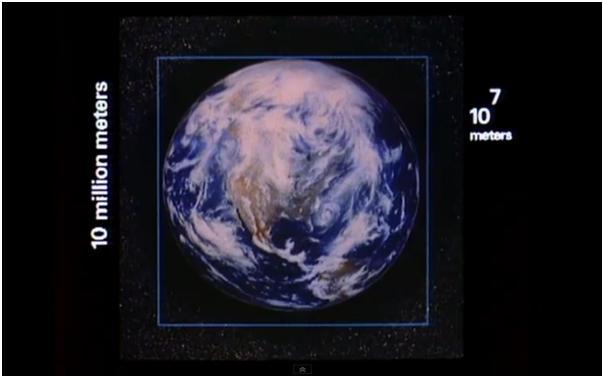
What I liked about the Eames' films, is this loose sense of magnitude that you get from them. Powers of Ten is pretty much an examination of spatial relations in one (or maybe two) camera movements. The way it's filmed is with one long continuous zoom-out, which is then reversed. That there is an odometer framing what we see is telling. By having the distance in metres either side of the image, we gain some abstract (as we don't actually count metres in our everyday experience) sense of spatial awareness.

What I also thought was interesting was the usage of the blue frame within the film, signifying a change in the factor of ten. Which I think gives the film a kind of telescopic aesthetic; you have frames within frames firstly moving away from you, then rapidly your perspectives flies through these frames and into the microscopic details of atomic and subatomic particles that make up the universe.

One of the most powerful images of Powers of Ten happens after about two minutes: the Earth taking up a dominant position at the foreground of the screen then slowly moving away until we can't see it anymore.


I think having the entire planet, there as the focal point of the screen, framed by a blue square and measurements in relation to where we began, highlights the aesthetics of perspective which are at the heart of Powers of Ten.

In complete contrast is House, which is more like a collection of photographs sliced together. Unlike the smooth movement of Toccata for Toy Trains or Powers of Ten, House seems a bit more stilted. The effect of this is to highlight more forcefully the differences in perspective, but I think, aesthetically at least, the House is perhaps less interesting than Powers of Ten or Toccata. You do have a wider variety of shot angles in House though, again, reinforcing this idea of perspective, and linking back to the doll's eye view idea. In House it's more of a flower's eye view, with slight but semi-jarring changes in pace.

Anyway, in conclusion, here is a Simpsons parody video I found.

Metablog

In keeping with the discourse of our last seminar, I thought I'd write a few, slaphazard thoughts about learning, education, pedagogy, etc. and the role that blogging has played so far in our class and to some extent our learning, at least from my perspective. I'm going to unashamedly announce that I'm all for this plural, dialogic type of learning for a few reasons. I should also probably admit that I'm very distrustful of mainstream, topdown schooling. If anyone has some spare time, read a few chapters of John Taylor Gatto's book The Underground History of American Education. It probably has little relevance in this space but 'tis interesting at least.

One of the more interesting points raised in last week's seminar was that by our teacher/lecturer Melissa Hardie. Basically she mentioned that there was a tendency in this season's class to write in more academic, formal style. Which is probably true, my blogs so far, apart from a few exceptions, have been in some ways formal, if at least a bit more personal(mind, I don't think simply by using pronouns and inserting yourself into what you write makes it any less formal or academic, at least in terms of circulating ideas). What I will say though, is that the Internet in all of its forms is a site of social performance. That is, we upload pictures and comments and essays and hyperlinks in either the knowledge or the hope that someone will look at them. And like all good performers we perform to our audience. Which is each other and the teacher. Therefore I think the micro-environment these blogs occupy encourages us to write in a formal, albeit friendly, style. At least that's my feeling, one great thing is the kind of liberation you get writing these blogs. I think also though, and I know I've certainly felt it to begin with, there's a kind of performance anxiety (not in the sexual way but if blogs make you feel that there's probably some deeper psychological trauma happening somewhere) happening at an intellectual level. As someone mentioned in class, you can say throwaway sentence to sound well-informed safe in the knowledge that everyone will forget by the time you've stopped speaking, assuming they're paying attention to begin with. With a blog your thoughts are there, more or less permanently, present until you delete them.

Those are more or less my big (and probably unoriginal and ungood :P) ideas on blogging and how it works. Seeing as this is a blog on networking, and educational networking (although there are times when I think the whole point of being at University is to accumulate piles of nepotism to expend later when you graduate and need coin) and I am in a free associative mood, here's a link to Zadie Smith's review of The Social Network. Not that Facebook is a big part of this course so far, but we quite easily could have had single discussion group for this subject as opposed to seperate, disparate blogs. I'm glad we didn't mind, but that could quite easily have been an option.

Modernity, Vertov & The Priveleged Machine

One thing that struck about Vertov's Man With A Movie Camera and the modus operandi of the kinoks' manifesto was the unflinching priveleging of machine above man. I found something dehumanising about it all to be honest, particularly with statements like the following: "In an art of movement with have no reason to devote our particular attention to contemporary man....The machine makes us ashamed of man's inability to control himself....For his inability to control his movements, WE temporarily exclude man as a subject for film."  There just seems something odd with this "precise study of movement" Vertov seeks to achieve with his film. Particularly considering that the human figure is featured throughout the entirety of the film either on screen or implicitly behind the camera it seems to be a fruitless task to attempt to make some sort of robotic, perfectly precise form of movement. Maybe it's just that I find the repetitive labour of "saws dancing at a sawmill" aesthetically boring. I do think Vertov succeeds at one level however, mainly through his technique. The extreme manipulation of human figures, for example in the middle of the film when the camera is held on an image of an old woman, in an aesthetic sense transforms those figures into visual-machines manipulated and, in a sense, programmed by the film-maker. Or the images of the band at the beginning of Man With A Movie Camera frozen in time until the film-maker pushes a button. I think the angular style deployed by Vertov and the constant and quick juxtapositions of human figures and industrial machines blends the two, but it left me feeling disconcerted and, frankly, cold.

There was also something incongruous about the celebration of "the delight of mechanical labour" apparent throught Man With a Movie Camera. Vertov's use of Dutch angles and low-shots of various factories and machines gives them a sense of grandeur, elevating them literally and metaphorically. I think it's perhaps a class thing; it seems very easy and self-interested to aggrandize the repetitive toil of the factory worker from behind a camera lens at the top of a skyscraper. Vertov indeed was part of the agitation-propaganda arm of the Communist Party and this jingoistic sense of national pride which permeates the film, through the triumphant images of Soviet sportsmen and women and the slow zooms of Lenin and Marx towards the end,  made me feel uneasy. However, the early 20th Century was a pinnacle for the idea of the nation-state, so I suppose context should be taken into account. Still, in my viewing of the film I couldn't help but notice that the subtle overtones of nationalism were incongruous with the opening images of beggars and children waking in the street; I suppose for a son of Jewish intellectuals Romanticizing the simple life of a street urchin, at least through the visual art of cinema, comes rather easily. 

So I'll leave it there with a final question for anyone who happens to read this. Do you think that dehumanisation, on any level, is a symptom of modernity?
 

The Musicality of Ruttman's Berlin:....

A point was raised in last week's seminar on Walter Ruttman's Berlin: Die Sinfonie der Großstadt concerning, at least as I understood or perhaps have falsely remembered, the affective qualities of music on our experience and interpretation of film. To confess, I found it difficult to watch Berlin in silence. After five minutes, following a recommendation from The Internet Archive, I spun some Kraftwerk and felt comfort, ease, joy even. Not because of the music but because a silent experience of Berlin seemed, somehow, alienating. Maybe Ruttman wanted it that way. What's more likely is that you and I are so used to the gift of sound and vision that we want, perhaps need, to experience films as we, those of us who are neither blind nor deaf nor both, experience the world: noisily, visually, with sight and sound. That "symphony" is included in the title of the film is clue enough.


I don't really have much more to say on the subject, other than a request for any critical theory surrounding these ideas and an embedded video I found on YouTube, where someone (Akbar) has taken the first five minutes of Berlin and added a bad synthpop soundtrack. It's not really that interesting, but this concept of "the musicality of the avant-garde" introduced by the YouTubber seems like it's worth thinking on. 


Test Post//FonTz Game

A a B b C c D d E e F f G g H h I i J j K k L l M m N n O o P p Q q R r S s T t U u V v X x Y y Z z

a b c d e f g h i j k l m n o p q r s t u v w x y z Z Y X W U V T R S Q P O N M


a b c d e f g hijklmnopqrstuvwxyz

ABCDEFGHIJKLMNOPQRSTUV

I'LL SAVE YOU! DA-DA-DA-DAH!

abcdefghijklmnolpqrstuvwxyz

Dopamine, quiet dopamine....

P.S: Ff#j Fvck FUBqnf!